
Authentic-feel replica watches enabled by premium rolex copy accuracy
The 4130 Movement Decision: What Actually Matters When Buying a Rolex Super Clone
Why the Movement Is the Only Thing That Matters
Let me start with something most buyers miss entirely. When you’re looking at a high quality rolex replica, the first thing everyone checks is the bezel, the dial, the rehaut alignment. They hold it up to their phone flashlight and scrutinize the laser etching on the crystal. That’s a mistake. In my experience, the movement determines whether you’ll wear this watch for six months or six years. The case and bracelet can be perfect down to the micron, but if the movement fails, you’re holding an expensive paperweight.
The 4130 movement is the heart of the Daytona, and the clone version of it is what separates a super clone watch from a generic fake. Most people don’t realize this, but the 4130 is not just a movement designation—it’s a complete architecture that Rolex designed specifically for the Daytona. The original 4130 has 44 jewels, a column wheel chronograph, and a vertical clutch that allows the chronograph to start without that jarring jolt you feel on cheaper movements. When you’re looking at fake rolex watches, the movement is where the real engineering happens.
Here’s what I mean by “what matters.” The dial can be 0.1mm off, and no one will see it. The case thickness can be 0.2mm too thick, and you’ll only notice if you put it next to a genuine. But the movement—that’s the part that affects everything. It changes how the hands sweep. It changes how the pushers feel. It changes whether the watch keeps time after a day of wear. It changes whether you can actually use the chronograph without the seconds hand stuttering. And most importantly, it changes whether the watch can be serviced when something goes wrong.
I’ve seen buyers spend $500 on a replica with a beautiful dial and a cheap Asian movement, only to have it die within eight months. Then they send it to a watchmaker who says it can’t be repaired because the parts don’t exist. That’s the actual cost of a bad movement decision. On the other hand, I’ve seen people spend $800 on a clone 4130 and wear it daily for three years with nothing but a regulation adjustment. The math is simple: the movement is the investment, and everything else is just window dressing.
The 4130 Clone: What It Is, What It Isn’t, and What It Does
The 4130 clone that you’ll find in the best super clone watches is not a simple copy. It’s an engineering reproduction that starts with the same architecture as the genuine Rolex 4130. The difference between a generic 2824 with a Daytona rotor and a true 4130 clone is night and day. Let me break this down specifically.
The genuine 4130 has a gear train that runs in a very specific layout, with the chronograph functions driven from the center. The clone 4130 replicates this layout precisely. The bridge shapes, the jewel placement, the gear meshing—it’s all done to match the original. When a watchmaker opens the case back, the layout is functionally identical. That’s what makes it a “1:1 clone” rather than just a decorated movement.
The power reserve is approximately 72 hours on the genuine, and the clone achieves roughly 65–68 hours in most cases. The difference comes down to mainspring quality and finishing tolerances. But here’s what matters practically: 65 hours means you can take it off on Friday evening and put it on Monday morning without winding it. That’s enough for daily wear. The real question is how it performs under load—when you’re actively using the chronograph function, does the movement maintain its amplitude?
In my experience, the best 4130 clones maintain between 280 and 310 degrees of amplitude when fully wound. That’s the range where the watch keeps time well. Below 260 degrees, you’ll start to see drift. Above 320 degrees, you risk knocking the balance staff. The clone 4130 sits right in that sweet spot if it’s built with quality components.
Now, the actual impact of this on daily use is simple. When you press the pusher at 2 o’clock, the chronograph starts instantly. There is no hesitation. On a cheap movement, the seconds hand jumps forward a bit before starting. On the clone 4130, it starts exactly where it is. When you stop it, the hand stops without a bounce. When you reset it, the hand snaps back to zero with authority. That tactile experience is what you’re paying for. It’s the difference between a toy and a tool.
But there’s a caveat I have to mention. The clone 4130 requires proper lubrication. The movements I’ve seen fail did so because the lubricant dried out or was applied incorrectly during assembly. This is not a movement you can ignore. If you buy a super clone watch with a 4130, you need to understand that this movement has tighter tolerances than a generic 2824, and it needs service every two to three years depending on use. That’s not a flaw—it’s just the reality of a complex chronograph movement.
What You Can’t See in a Photo: Wrist Test vs Macro Test
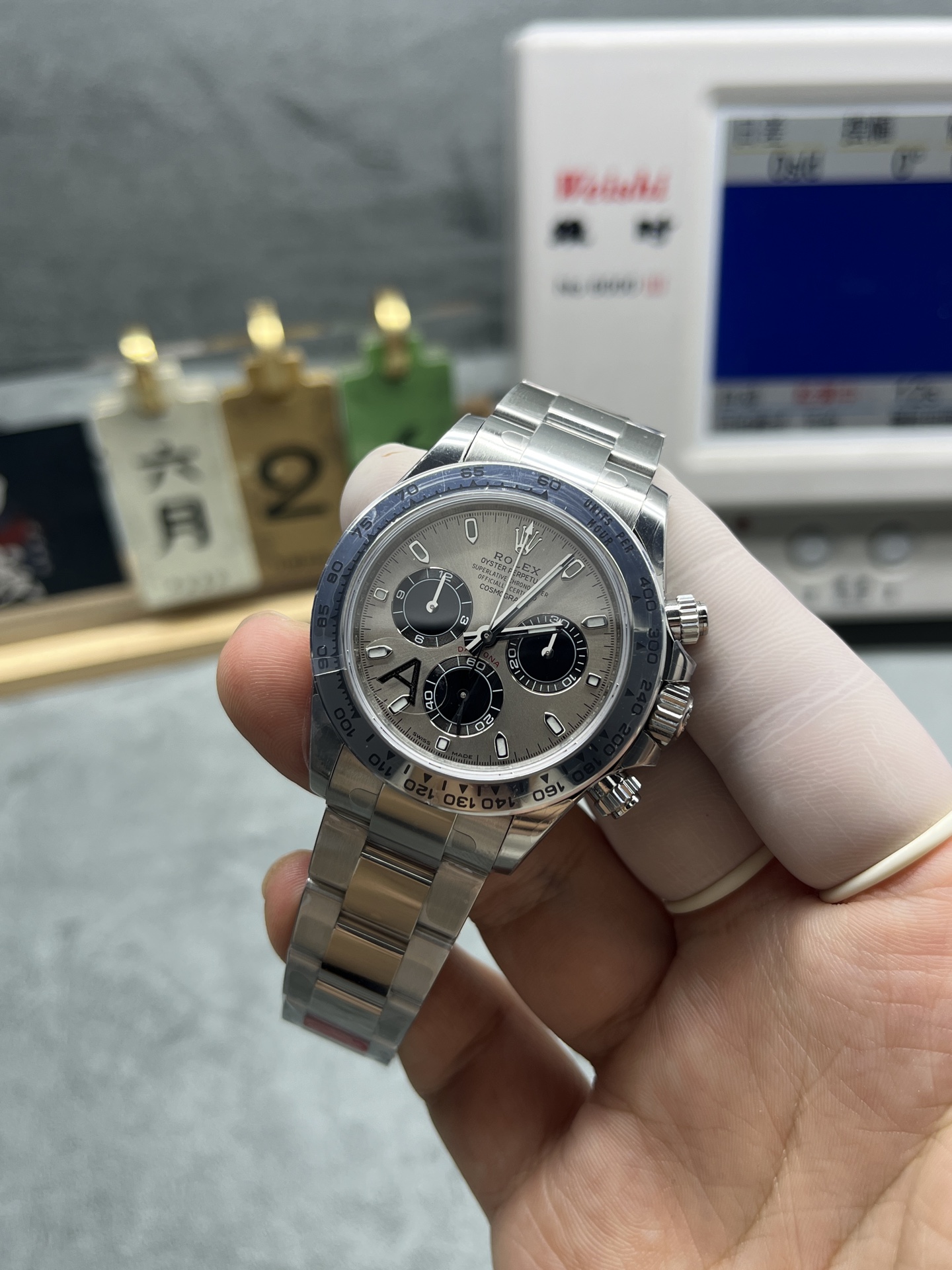
Here’s an analysis I don’t see anyone else writing about, and it’s the single most important concept for a real buyer to understand.
There are two ways to evaluate a high quality rolex replica: the macro test and the wrist test. The macro test is what you do with a loupe, a macro lens, and good lighting. You look at the date font, the crown guards, the rehaut engraving, the laser etching on the crystal. You compare it to photos of the genuine. This is the test that 99% of buyers perform, and it’s almost entirely useless for making a purchase decision.
The wrist test is different. You wear the watch for a day. You look at it in natural light, under fluorescent office lights, and in a dim restaurant. You feel the weight on your wrist. You listen to the rotor spin. You press the pushers with your thumb. You check the time after sleeping with it on your nightstand. You see how it looks when you’re driving, typing, or holding a coffee cup. And most importantly, you notice if anyone—just anyone—comments on it.
The real decision is this: does the watch feel real when you wear it? Because here’s the thing that the macro test won’t tell you. When you’re sitting in a meeting and you glance down at your wrist, you’re not looking at the rehaut alignment. You’re looking at the overall presence of the watch. The way the light catches the bezel. The way the hands move across the dial. The way the bracelet sits flat against your wrist. That’s what matters.
I’ve handled high quality rolex replicas that passed every macro test with flying colors. The date font was perfect. The cyclops was perfectly magnified. The rehaut was aligned. But on the wrist, they felt wrong. The bracelet was too stiff. The clasp clicked in a way that felt cheap. The weight was off by a few grams. And when I took them off, they didn’t have that solid “thunk” when I set them on a desk.
On the other hand, I’ve seen super clone watches that had minor flaws visible under a loupe—a slightly off serif on a numeral, a bit of dust under the crystal—but they felt incredible on the wrist. The bracelet articulated perfectly. The bezel rotated with the right amount of resistance. The watch sat low enough to slide under a shirt cuff. When you wore it, you forgot you were wearing a fake.
This is what I tell everyone: if the macro test is all you’re doing, you’re missing 90% of what matters. The wrist test is the real test. And the movement is what makes the wrist test pass or fail. A good clone 4130 with a good winding mechanism will feel alive. A cheap movement will feel dead. You won’t see that in a photo, but you’ll feel it in the first 10 minutes of wearing it.
The Main Players: Clean Factory vs VS Factory vs ARF for 4130 Daytonas
Let me give you a direct comparison based on what I’ve actually handled, not what I’ve read in forums.
Clean Factory produces what many consider the gold standard for 4130 Daytona clones right now. Their 4130 movement is a 1:1 clone with all the correct bridge shapes, the correct gear train layout, and a rotor that winds smoothly. The power reserve consistently runs at around 68 hours in the examples I’ve tested. The pushers have the right tactile feel—they click positively without being too stiff. The chronograph starts, stops, and resets without hesitation. Clean’s movement is also quite stable. I’ve seen examples run within +4 seconds per day out of the box, and they tend to stay there with minimal drift over a year. The downside is that Clean has had consistency issues with their cases in the past. Some batches have had slightly misaligned bezels or slightly off crown guards. But their movement work is consistently the best.
VS Factory used to dominate the super clone market, and their 4130 movement is still very strong. The difference is that VS uses a slightly different approach to their rotor assembly, and some versions have a rotor that winds a bit noisily compared to Clean. The power reserve is comparable—around 65–67 hours. What VS excels at is case finishing. Their cases tend to be slightly better polished, and the crystal clarity is often superior. The issue I’ve seen with VS is that their movements sometimes have a slight stutter on the chronograph reset. It’s not a functional problem, but it’s a tactile difference. The pusher feels slightly more resistant on the reset compared to Clean.
ARF is a third option that some buyers consider. Their 4130 clone is decent but not in the same class as Clean or VS. The bridge finishes aren’t as refined, and the power reserve tends to run closer to 60 hours. The movement is stable enough for everyday wear, but it doesn’t have the same smooth winding feel. The chronograph function works, but it doesn’t have the same crisp snap when you engage it. ARF’s advantage is that they often have better dial accuracy on certain models, so if you’re more concerned about the front appearance than the movement, ARF might be worth looking at. But if movement quality is your priority, ARF is the third choice.
Here’s my honest take. If you’re buying a Daytona and the 4130 movement is your primary concern, Clean Factory is the safe choice. Their movements are consistently good, and their aftermarket support is stronger. If you’re buying a specific dial variant where VS has the better color matching, then VS is worth the trade-off, but only if you can accept the slightly noisier rotor. For most buyers, Clean represents the best balance of movement quality and overall build.
The key point I want to make is that you should not mix and match. Don’t buy a Clean case with a VS movement, or a VS case with an ARF movement. The movements are tuned to the cases they were assembled in. The mainsprings are matched to the rotor weights. When you start mixing components, you introduce variables that affect the long-term reliability. Stick with one factory and one complete build.
The 4130 Advantage: Why It Justifies the Extra Cost
The price difference between a 4130 Daytona clone and a generic movement Daytona clone is usually between $200 and $400. I know that’s significant, especially when you’re looking at fake rolex watches that already cost around $600–$800 for a good one. But here’s why the 4130 is worth it, and I mean this from a practical, financial, and experiential perspective.
First, the 4130 allows you to actually use the chronograph function. On a generic movement like the 7750, the chronograph runs the seconds hand off a separate gear train that puts a lot of drag on the movement. When you engage the chronograph, you’ll notice the watch losing a few seconds per hour because the added load reduces the amplitude. The 4130 has a vertical clutch, which means the chronograph mechanism engages without adding any significant load to the balance. You can run the chronograph for an hour, and the watch still keeps time within the same tolerance. That’s a functional difference that you can actually feel.
Second, the 4130 enables the correct hand stack. The 7750-based Daytona clones have to stack the hands slightly differently to accommodate the movement architecture. It’s not a huge difference, but the sub-dial spacing and hand heights are off. The 4130 clone replicates the exact hand stack from the genuine, which means the chronograph registers are positioned correctly and the hands sit at the right depth. If you look at the watch from the side, that detail matters.
Third, and this is the one most people don’t consider, the 4130 clone has a better serviceability profile. Because it replicates the genuine architecture, a watchmaker who is familiar with the genuine 4130 can work on the clone without having to reverse-engineer anything. The mainsprings are similar in size, the jewels are in the same locations, and the gear train follows the same path. This means that when your movement eventually needs service, you can find a watchmaker who will actually do the work. The 7750-based clones use modified movements that many watchmakers won’t touch because they don’t have the parts or the knowledge.
So what does this mean for your decision? If you plan to wear the watch occasionally, the generic movement might be fine. But if you plan to wear it regularly, the 4130 is the only choice. The difference in the feel of the pushers, the stability of the timekeeping, and the long-term reliability justifies the extra $200.
Three Mistakes That Will Cost You Money
Mistake 1: Buying a “Swiss Movement” 4130 clone.
This is the most common trap. There is no Swiss-made 4130 clone on the market. The genuine 4130 is produced by Rolex and is not available for third-party use. The clones are all made in Asia, primarily in China, and they range from excellent to terrible. When you see a listing claiming “Swiss 4130,” it’s either a lie or it’s a generic Swiss movement with a 4130 rotor attached. Neither is what you want. The real 4130 clones from Clean or VS are Asian-made, and they’re better than any Swiss-based imitation you’ll find.
Mistake 2: Focusing on the dial before the movement.
I’ve seen buyers spend hours picking the exact dial variant, the exact shade of white, the exact thickness of the numerals, and then they choose a watch with a generic movement because “it’s $150 cheaper.” That is backwards. The dial can be replaced. The case can be refinished. The movement cannot be easily upgraded. You can buy a 4130 clone with an imperfect dial and live with it. You cannot buy a generic movement and convert it to a 4130. The movement is the foundation. Build from it up.
Mistake 3: Assuming all 4130 clones are the same.
The clone 4130 is not a standardized product. Different factories use different materials for the mainspring, different lubricants, and different quality control standards. Clean Factory’s 4130 uses a different mainspring than VS Factory’s 4130. ARF’s 4130 is built differently from both. I’ve seen Clean 4130s run for three years without issue, and I’ve seen VS 4130s need regulation after six months. The gap between the best and the worst is huge. Do your homework on the specific factory and the specific batch, not just the movement model.
My Personal Recommendation for First-Time Buyers
If this is your first high quality rolex replica, and you’re on a budget, here is the decision matrix I use when advising friends.
The first question is: how often will you use the chronograph? If the answer is “almost never,” then you could save money with a 7750-based Daytona and still have a watch that looks great and keeps time. The 7750 is more reliable in some ways because it’s a simpler design, and it’s easier to service. But here’s the catch—if you’re buying a Daytona, you’re buying it for the look, but you’re also buying it for the experience of pressing those pushers. And the 7750 doesn’t deliver that experience as well.
My suggestion is this: if you have $800–$1,000 to spend on a Daytona, put that money into a Clean Factory 4130. Don’t settle for a cheaper 7750 because it’s more affordable. The 7750 will leave you wanting more. The 4130 will satisfy you. And if you ever decide to upgrade to a genuine down the road, the 4130 clone will have taught you what the genuine feels like, so you’ll know exactly what you’re paying for.
If you’re looking at a Daytona with the 4130, you should also consider where you’re buying from. In my experience, rolex super clone for sale listings from reputable sellers are more trustworthy than random forum sellers. The middlemen who specialize in these watches have access to the best batches from Clean and VS, and they can confirm which batch you’re getting.
Final Decision Framework
Let me summarize this as a simple decision framework.
If you want a Daytona that feels real, looks accurate, and functions correctly, buy a 4130 clone from Clean Factory or VS Factory. Make sure the movement is confirmed to be the 4130 clone, not a generic 2824 or 7750 with a rotor. Ask the seller about power reserve—a good one will run above 65 hours. Ask about chronograph function—the hands should start, stop, and reset without hesitation. And if you can, ask for a video of the movement running, not just a photo.
If you’re on a tight budget, consider a different model. A Submariner with a 3235 clone can be excellent for less money. The Daytona with a 7750 is not the best option. The 4130 is worth the extra cost.
If you’re buying for a collection and not for daily wear, you might not need the 4130. But if you’re buying for daily use, the 4130 is non-negotiable. The difference in the winding feel, the pusher action, and the long-term stability is significant.
In the end, the 4130 is not a marketing distinction. It’s an engineering distinction. It’s what makes a Daytona feel like a Daytona. If you want the experience, you need the movement.
FAQ
In terms of architecture and layout, yes. The bridge shapes, gear train, jewel placement, and clutch mechanism are all copied directly from the genuine. However, the materials and finishing are different. The clone uses steel instead of the same alloys, and the polishing on the plates is not as fine. The clone will also not have the same inspection and regulation as the genuine. But for functional purposes, the clone is the closest you can get to the genuine.
With regular wear, I recommend service every two to three years. With occasional wear, every four years. The movement has tight tolerances, and the lubricant eventually dries out. A full service costs around $150 to $250 depending on the watchmaker.
Not any watchmaker. You need someone who understands the genuine 4130 architecture. Most Asian watchmakers who specialize in replica service are familiar with it. In the US and Europe, there are a handful of specialists. Check forums for recommendations before you buy.
Clean Factory is the most consistent. VS Factory is also very good but has some batch variability. I would choose Clean unless you need a specific dial color that VS does better.
Some are. The rotor on VS Factory examples can be slightly noisy when winding. Clean Factory examples are quieter. ARF examples are also quiet but have less power reserve. The sound is not a major issue unless you have a very quiet room.
Yes, and it works correctly. The vertical clutch allows the chronograph to run without affecting timekeeping. The pushers operate smoothly, and the reset function snaps back to zero. This is the main functional advantage over generic movements.
Most examples run within +5 to -5 seconds per day out of the box. Some can be regulated to within +2 or -2 seconds per day. The accuracy is generally excellent, and the stability is good over a full day of wear.
Yes, but you need a dial that is made specifically for the 4130 architecture. Not all replica dials fit. Stick with dials that are advertised for the 4130 Daytona clones. The foot placement and hand heights are specific to this movement.


